


Directors bring valuable experience, knowledge and perspectives to the boardroom. Yet meetings can easily become dominated by reports, compliance and process.
Good governance is not about doing more. It’s about focusing the board’s attention where it can add the most value.
So ask: Whose perspective are we missing? What should we be talking about that we’re not? And how will today’s decisions shape the club’s future?
1. Put Strategy First
Review your agenda. Where does the conversation about the club’s future sit? If it comes after the minutes, financial reports, committee updates and policy reviews, the board may reach its most important discussion when time and energy are running short.
Try putting one meaningful strategic question near the start of every meeting:
- What’s changing that could affect our club?
- Are we still on track with our strategic priorities?
- What are our members and community telling us?
- What emerging risk or opportunity needs our attention?
- What important decision are we putting off?
Boardroom tip: Don’t leave strategy until the end of the agenda. Give the club’s future some of the board’s best thinking time.
2. Make Constructive Disagreement Part of the Conversation
A strong club board doesn’t need to agree on everything. In fact, respectful challenge can lead to better discussion and more considered decisions.
For an important decision, encourage directors to deliberately look at the issue from different perspectives. Edward de Bono’s Six Thinking Hats provides a simple way to structure the discussion:
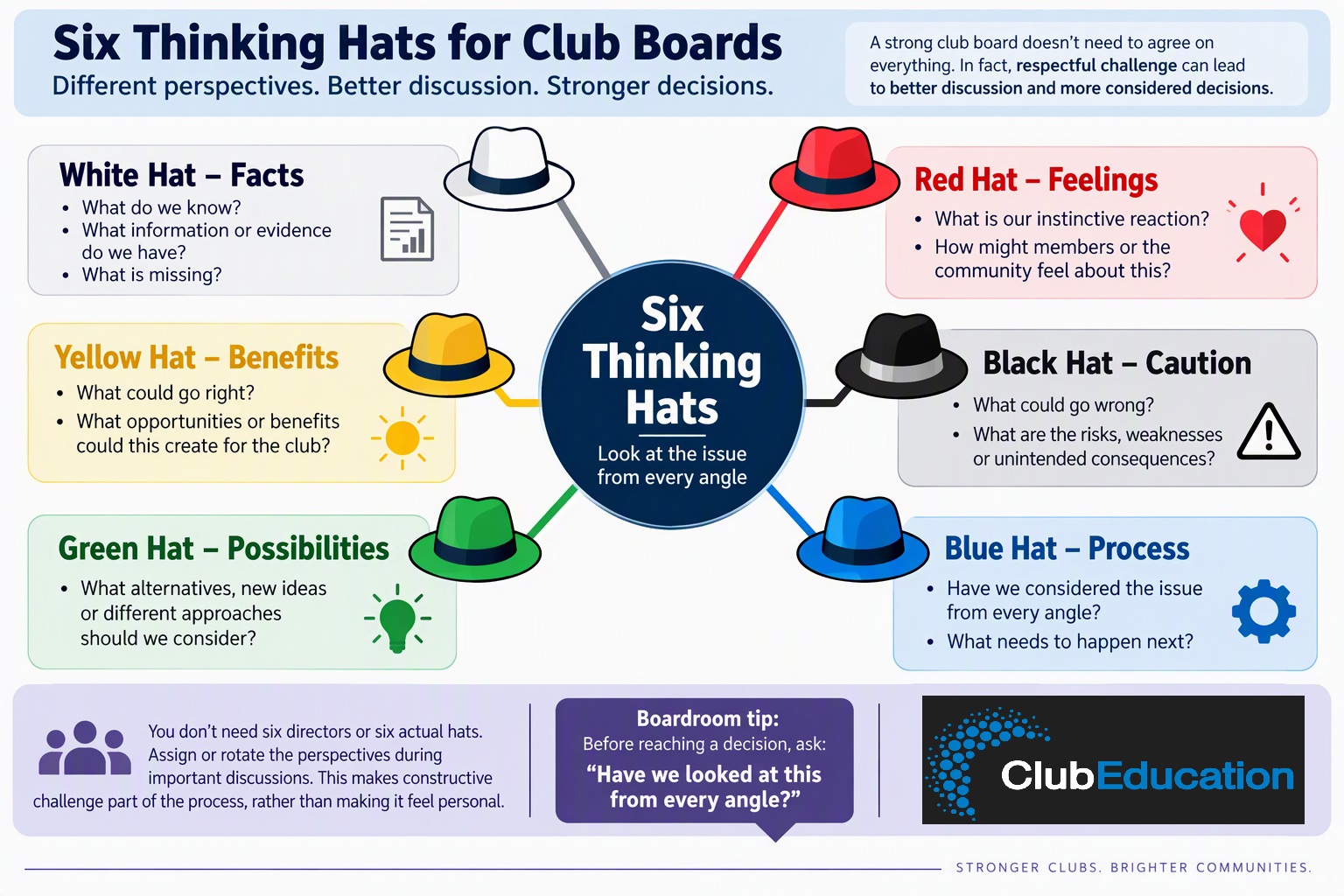
You don’t need six directors or six actual hats. Assign or rotate the perspectives during important discussions. This makes constructive challenge part of the process, rather than making it feel personal.
Boardroom tip: Before reaching a decision, ask: “Have we looked at this from every angle?”
Download the six thinking hats mind map
3. Change Who Speaks. Make Space for Every Voice
Having diverse skills around the table means little if the same three people dominate every conversation. Give people time to think before a discussion. Invite quieter directors in first. Ask everyone to contribute before returning to those who have already spoken. Ask: What are we overlooking? If the people we exist to serve were sitting here, what might they challenge?
Boardroom tip: Before closing a significant discussion, ask: “Have we heard all the perspectives we need to make a well-considered decision?”
One Thing to Try
You don’t need to redesign your entire board meeting. At your next meeting, choose one of these ideas and try it. Small changes to how individuals question, challenge, listen and contribute can change the quality of the conversation around the board table.